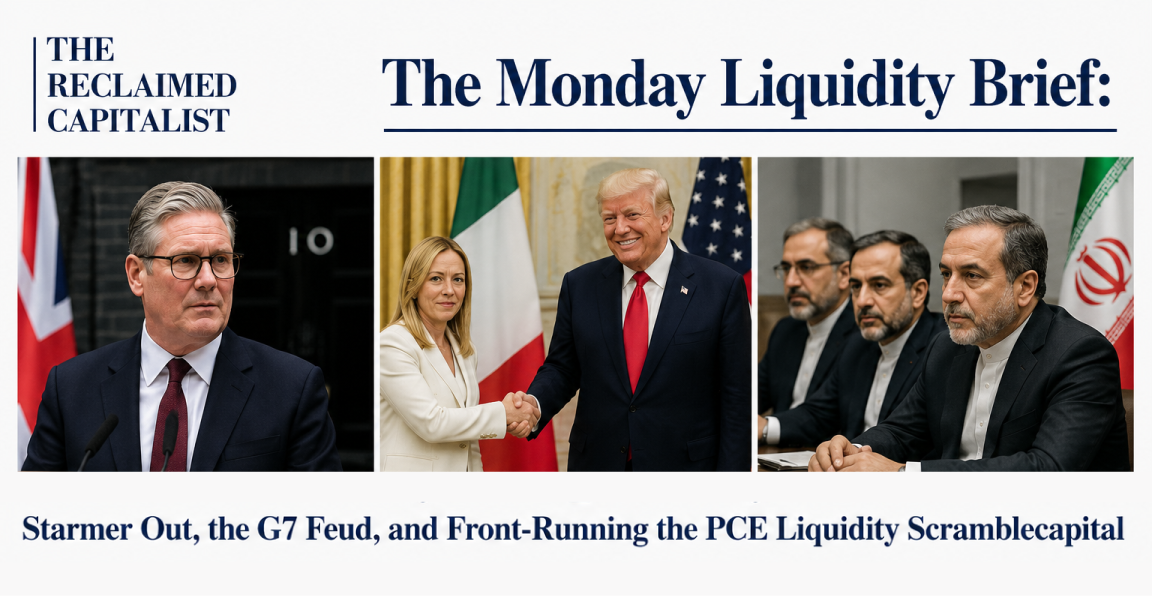
The Monday Liquidity Brief: Starmer Out, the G7 Feud, and Front-Running the PCE Liquidity Scramblecapital
Good morning, Sovereigns. Welcome to your Monday Brief.
What a weekend, and what an explosive start to the week. The corporate and geopolitical chessboards did not pause for a single second. While the mainstream press spent the weekend completely transfixed by superficial political optics, our job on this floor is to look past the entertainment to protect our long-term capital perimeter defense.
Every leadership vacuum in Europe, every fraying alliance in the West, and every tactical corporate statement directly impacts global liquidity, currency stability, and your portfolio layout.
Here is exactly what transpired over the weekend and what you must calculate for the week ahead.
1. The Transatlantic Fault Lines: Starmer Resigns, G7 Splinters
The absolute biggest geopolitical headline this morning is the sudden resignation of British Prime Minister Keir Starmer. Following a weekend of intense inner-party mutiny and the strategic Westminster return of rival Andy Burnham, Starmer stood outside 10 Downing Street to announce he is stepping down.
The mainstream media will frame this as a localized party dispute, but the reality is a massive leadership vacuum in a core G7 state at a time when Western political structures are already fracturing under inflationary pressures.
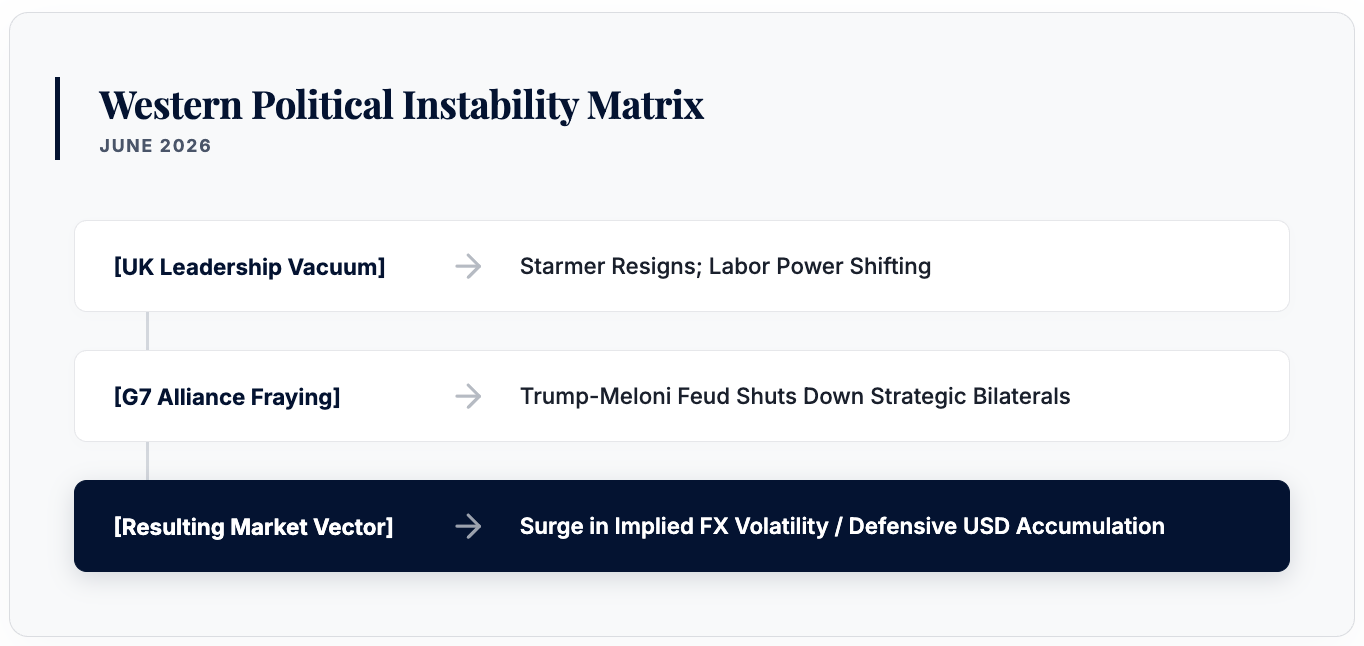
Simultaneously, a bizarre yet telling personal feud has erupted between Donald Trump and Italian Prime Minister Giorgia Meloni following the G7 summit in Évian-les-Bains.
Trump publicly claimed Meloni "begged" him for a photo-op because her domestic numbers are down, linking the spat directly to Italy's refusal to grant the U.S. use of its military runways during the peak of the Hormuz conflict.
Rome responded with anger, and Italian Foreign Minister Antonio Tajani promptly canceled his high-profile U.S. trip to meet with Secretary of State Marco Rubio.
Do not mistake this for simple high-school drama on the global stage. These public fractures among key Western allies reveal that behind the "peace and unity" talking points, the enforcement mechanisms of global trade routes and military alliances are fundamentally fraying.
This directly increases the risk premium across international assets and signals that the path toward global economic stability is heavily obstructed.
2. Decoupling the Corporate Bluff: The Tech Elite Re-Position
On the technology front, we are watching a highly calculated public relations maneuver masquerading as corporate altruism. Microsoft CEO Satya Nadella took to the pages of The Wall Street Journal to launch a targeted strike against his own frontier partners at OpenAI and rivals at Anthropic, pitching a new vision built around cheaper models, granular user control, and political compliance.
Nadella explicitly criticized the centralized, alarmist narrative of tech elites, stating: "You can't say: Hey, all white-collar jobs are gone, and this could even be a weapon, and we will use all the power to build data centers." He warned that the public will not tolerate a few select monopolies controlling all global learning.
My view?
This is a classic corporate bluff.
Nadella smells the intensifying antitrust, regulatory, and labor backlash building against the hyper-centralized frontier AI labs. By positioning Microsoft as the defender of decentralized, cost-effective computing, he is front-running the regulators.
He is intentionally shifting Microsoft's balance sheet away from expensive, single-point capital traps to protect his corporate margins, leaving his startup partners to absorb the political and legal heat.
3. Macro Mechanics: Front-Running Friday’s Crucial PCE Print
Turning to the macroeconomic data, the market is bracing for a massive reality check.
Following Kevin Warsh's fiercely hawkish debut as Federal Reserve Chair—where policy targets cemented a rigid 3.50% to 3.75% plateau—interest rate futures have aggressively pulled forward expectations for another potential rate hike to as early as October 2026.
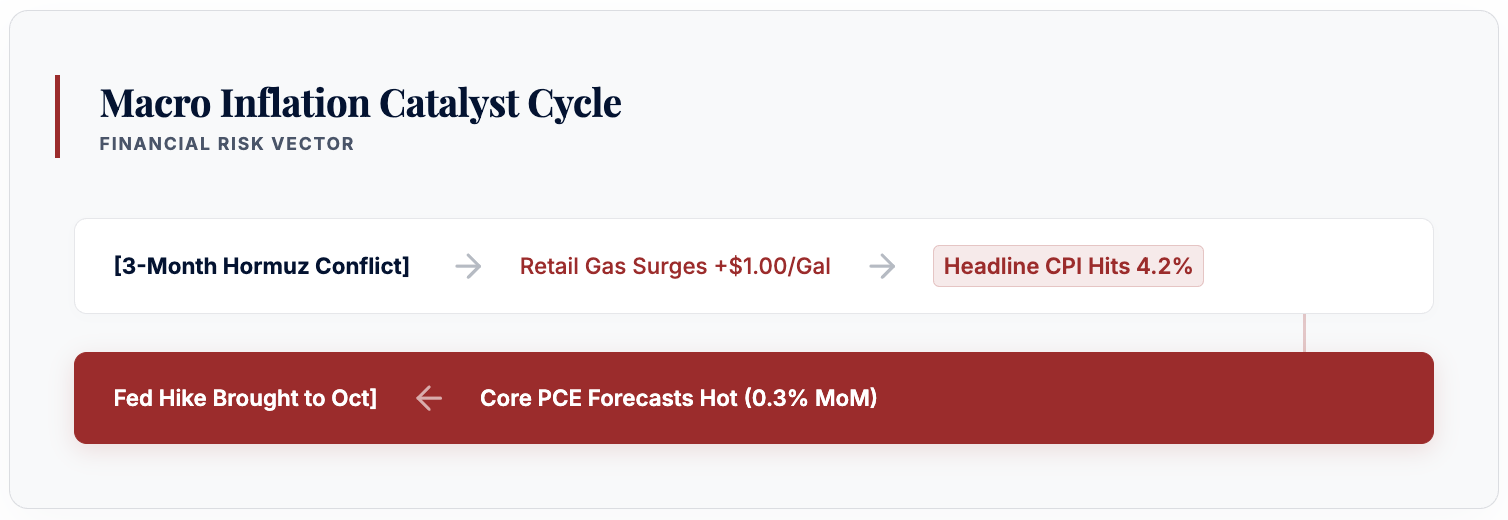
The true test of this monetary trajectory arrives this Friday with the release of the U.S. Personal Consumption Expenditures (PCE) price index, the Fed's absolute favorite gauge for consumer inflation.
Core PCE is currently projected to accelerate to 0.3% month-over-month, driven by the downstream lag of energy costs and retail gas prices that surged over $1.00 per gallon during the peak of the Hormuz blockade.
If this print comes in hot alongside Tuesday's flash PMI metrics, the "higher for longer" narrative will transform into an outright scramble for defensive liquidity.
Short-term Treasury yields are already opening at new cycle highs this morning, signaling that the smart money is lock-stepping into fixed-income duration to hide out from equity market overextensions.
The Sovereign Playbook: Tactical Allocations
When global leadership vacuums collide with hot macro prints and corporate repositioning, the autonomous allocator does not make emotional, one-way bets. We play the mathematical spreads.
- First, avoid chasing overextended tech index valuations. The initial index-inclusion buying frenzy that pushed SpaceX past a $2 trillion valuation is beginning to slow down. With Nadella openly telegraphing a structural shift toward cheaper, smaller AI models, the capital expenditures required for massive data-center builds may experience a localized cooling period. Hold a disciplined line on megacap tech exposure.
- Second, exploit the surging U.S. Dollar. The political upheaval in Downing Street and the public fracturing of G7 alliances are structurally bullish for the greenback as a defensive capital haven. As European political stability wavers over the summer recess, accumulating short-duration U.S. dollar assets provides an asymmetric buffer against broader currency volatility.
- Third, keep your capital powder dry ahead of Friday. A hot PCE print will trigger sharp asset repricings across risk-on equities. Rather than guessing the directional outcome of Friday's data, use this early-week window to lock in high short-term yields and prepare your cash reserves to pick up prime, cash-flowing infrastructure and real estate assets if a liquidity flush occurs.
Let the crowd obsess over political gossiping and social media feuds. Our eyes remain fixed on the underlying migration of hard capital.