
Wall Street is currently preparing a masterclass in financial delusion. While the front pages celebrate a new era of multi-trillion-dollar tech listings, the back pages show an American consumer that is completely running out of cash. We are stepping completely out of the cheerleading section to run a cold, mathematically rigorous audit on this disconnect.
To the retail public, these numbers are pitched as a testament to human innovation. To the sovereign investor, they represent a profound divergence from reality. Wall Street is trying to manufacture trillion-dollar valuations out of thin air at the exact moment the structural foundation of the domestic consumer is showing critical cracks. Our directive is to isolate the structural friction between these two balance sheets and weaponize it for premium collection.
1. The Numbers on the Ledger: Elite Multiples vs. Eroding Cushions
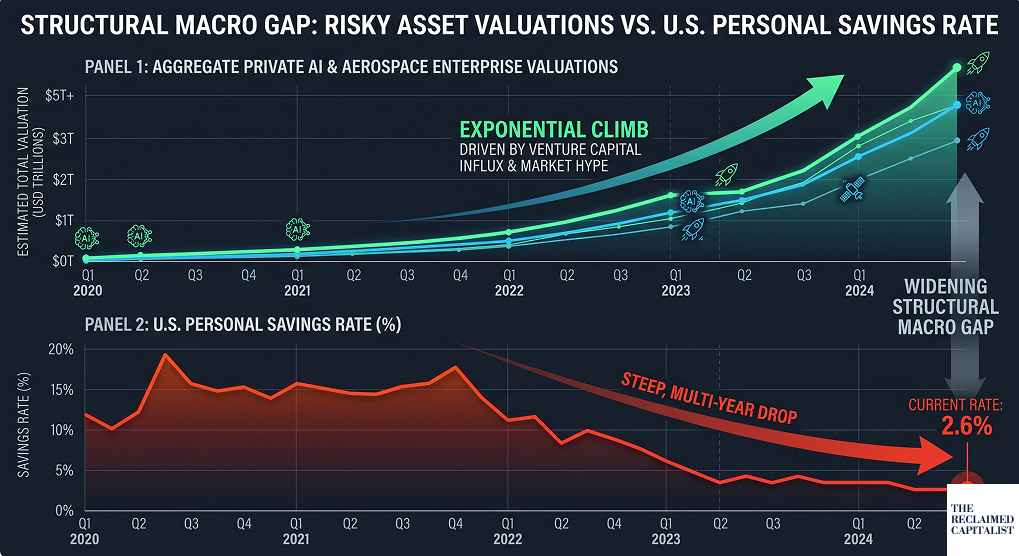
When you map out the tech landscape alongside the broader economy, the math simply does not match. On one side of the ledger, we see historically unprecedented valuations being prepped for public market distribution:
- The AI/Aerospace Anchors: SpaceX (NASDAQ: SPCX) has formally adjusted its IPO target to at least $1.8 trillion after consulting with underwriting syndicates. This sits alongside private market valuations for OpenAI at $852 billion and Anthropic scaling toward a near-trillion-dollar valuation target.
- The Capital Loop: Over the last five quarters, the rush to construct AI networks has driven tech infrastructure spending to insane levels. SpaceX’s own S-1 prospectus revealed the company swallowed a $4.94 billion net loss primarily due to spending over $20 billion on AI construction and absorbing xAI.
But flip the page to the consumer balance sheet, and the structural floor is giving way. The U.S. Bureau of Economic Analysis (BEA) reported that the personal saving rate plummeted to 2.6%. For every dollar earned, American households are saving a mere 2.6 cents—a dramatic collapse from the 5.5% saving rate recorded just twelve months ago.
2. The Underwriting Playbook: Escaping Before the Runway Ends
The core issue is that a $1.8 trillion valuation assumes a corporate revenue runway that can expand indefinitely. Yet, these massive operations ultimately rely on discretionary consumer dollars or enterprise budgets funded by consumer activity.
With household budgets heavily squeezed by inflation, elevated borrowing costs, and rising debt service thresholds, the average consumer is rapidly running out of discretionary runway. Wall Street underwriter syndicates—led by Goldman Sachs and Morgan Stanley—are fully aware of this macro friction.
This is precisely why they are compressing their timelines and pushing for these gargantuan listings now. They need to distribute these equity blocks to passive retirement accounts while retail enthusiasm is high, effectively transferring the structural risk before the consumption drop hits corporate top lines.
3. The Tactical Strike Plan: Capitalizing on Capital Volatility
We do not gamble our principal capital on unproven, momentum-driven IPOs with tight float restrictions designed to engineer brief price spikes. Instead, we extract high-probability income by writing out-of-the-money cash-secured puts on the liquid, mega-cap tech hyperscalers anchoring this ecosystem—specifically Amazon (NASDAQ: AMZN) and Microsoft (NASDAQ: MSFT).
- The Arbitrage: The extreme valuation gap between private tech targets and the real economy creates elevated implied volatility ($IV$). We treat this volatility as an asset class, selling it to panic-buyers seeking downside protection.
- The Structural Hedge: By utilizing short-duration option contracts (30–45 days to expiration), we aggressively harvest Theta decay. For portfolios requiring absolute risk boundaries against a broader macro pullback, we execute credit spreads to lock in upfront cash flow while maintaining a strictly defined downside ceiling.
4. The Sovereign Directive
True financial sovereignty means refusing to allow your capital to serve as Wall Street’s exit strategy. Traditional advisory firms will continue pushing passive wealth products that blindly absorb these multi-trillion-dollar issuances while charging asset-under-management fees.
We choose to remain anchored to the immutable data of cash flow and verified balance sheets. Let the broader market shoulder the execution and consumption risks of this overextended cycle; our mandate is to capture the options premium here and now.
Trillion-Dollar Mirages vs. A 2.6% Savings Rate: The Coming Macro Split
Turn the widening gap between tech valuations and real consumer math into steady cash flow.